


3D Cone Beam Imaging
How Is It Different from Ordinary Dental X-rays?
Typical dental x-rays just focus on your teeth, and for each x-ray picture, you need one exposure. So it would take many exposures to even begin to compare to a single 3D ConeBeam scan. But 3D ConeBeam Imaging shows much more than simple “flat” x-rays. This new technology provides more complete visual information to study your case from every angle. Best of all, the original scan data can be duplicated anytime, to provide different specialists with images if needed later. And, there’s no film to get lost.
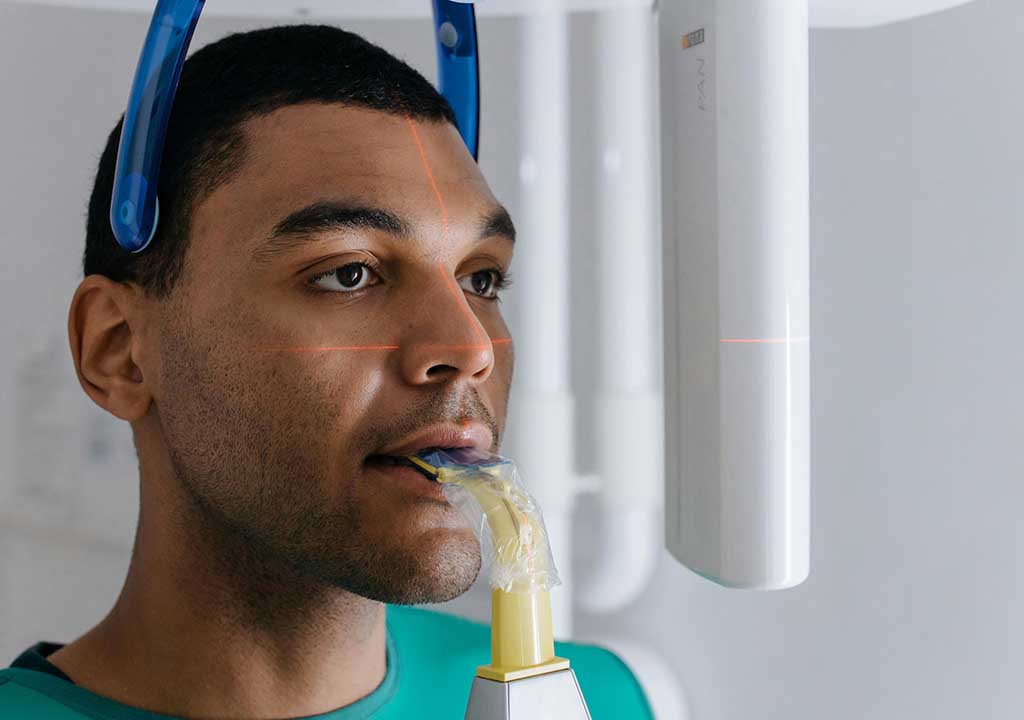
How Does It Work?
The 3D ConeBeam Imaging system is basically a digital x-ray scanner mounted on a rotating arm. (Like a digital camera, it uses digital technology to record images instead of old-fashioned film.) It’s called “ConeBeam” because the scanner projects x-rays in a carefully controlled, cone-shaped beam.
You simply stand in position while the scanner moves in one complete circle around your head, gathering all the scan data needed. There’s no special preparation necessary.
Your dentist can then call up whatever views they need on a computer monitor: 2D, 3D, “panoramic” views of your entire mouth, even sequences like pages in a book. They can view your images from any angle and in different magnifications, to see the relationships between bones, teeth, airways, nerves and tissues; to plan or evaluate your treatment.
And while 3D ConeBeam Imaging produces the same kind of high-quality images as a Medical CT scan, it does so with much less radiation.

More Information
- No pre-scan preparation required
- Quick, simple, completely painless
- A virtually infinite number of views from just one 10-20 second scan
- Lower radiation dose than conventional CT scans
- Gives you the confidence that your doctor has advanced, precise information to plan and monitor your treatment
3D Cone Beam Imaging
Why Do I Need It?
Whether you’re just beginning treatment or evaluating the results, 3D ConeBeam x-ray images give your dentist more of the high quality, detailed visual information they want for diagnosis and planning. More complete information is a vital key to improved patient care. And for you, it can mean more confidence and satisfaction in your treatment.
FAQs
Yes. A cone beam scan uses X-rays, so there's a small amount of radiation, but the dose is low. It's higher than an everyday dental X-ray but far lower than a hospital CT scan, and for a typical implant scan it's broadly comparable to the natural background radiation we're all exposed to over a few days to a few weeks. We only ever take a scan when it will genuinely help plan or check your treatment, and we keep the dose as low as possible. For implant surgery, the detail it gives is what makes the treatment safer, which is the whole reason for taking it.
They produce similar quality 3D images, but a cone beam scan is built specifically for teeth and jaws, so it focuses on a small area and uses far less radiation than a full medical CT. It's also quicker and more comfortable. The machine is open, so there's none of the enclosed-tunnel feeling people associate with a hospital scanner, and there's no injection or dye involved
An ordinary X-ray is flat, so it can't show everything we need to place an implant safely. A 3D scan lets us measure the exact height, width and quality of your bone, and see the position of important structures like the nerve in your lower jaw and the sinuses in your upper jaw. That means we can plan precisely where each implant should go, work safely around those structures, and often carry out guided surgery for a more accurate result. In short, it makes your treatment both safer and more predictable.
For the vast majority of people, a cone beam scan is a safe and simple part of implant planning. The main thing to mention is pregnancy: if you're pregnant or think you might be, let us know, and we'll decide together whether to go ahead now or wait, since we avoid any non-essential imaging during pregnancy. Otherwise there's very little to think about. We always check that a scan is genuinely needed before taking one, so it's never done routinely without good reason.
Get in touch today
For more information on 3D Cone Beam Imaging, call us on 0115 981 6986 or book a consultation.
